
A smarter kind of brain training.
NeurOptimal® is a neurofeedback system that helps the brain optimize its own performance. It doesn’t push the brain in any particular direction and doesn’t require a diagnosis. Instead, it provides real-time information about the brain’s own electrical activity, giving it the opportunity to self-correct.
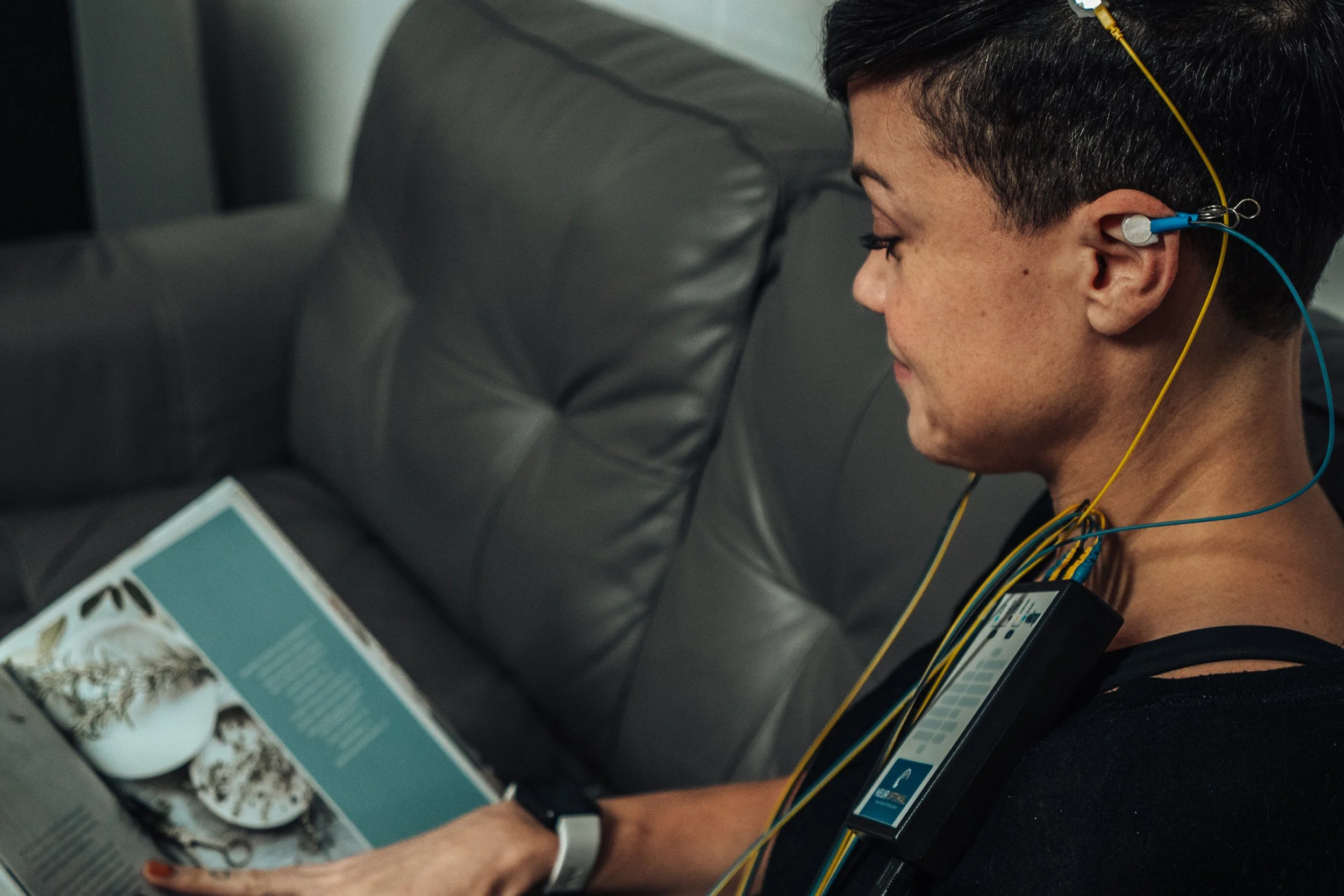
How It Works — The Simple Version
Two small sensors are placed on the scalp and three on the ears. These read the brain’s electrical activity (EEG). Headphones go on, and music plays for about 33 minutes.
While the music plays, the software monitors brain activity 256 times per second. When it detects that the brain is about to make a sudden, inefficient shift, it creates a brief micro-pause in the music. The interruption is subtle, but the brain registers it — each micro-pause is a cue to notice what just happened and re-orient.
Over multiple sessions, the brain becomes better at self-regulation — more flexible, more stable, and less likely to get stuck in unhelpful patterns.
-
NeurOptimal® is a Dynamical Neurofeedback® system, developed by Drs. Val and Sue Brown over decades of clinical work. Unlike traditional “linear” neurofeedback — where a practitioner selects which brainwave frequencies to train based on a diagnosis — NeurOptimal® works with the brain as a non-linear, dynamical system.
The software uses mathematical algorithms to detect moments of turbulence in the brain’s electrical activity. When it detects these moments, it sends an auditory cue (the micro-pause) that alerts the brain to what just happened. Nothing is added to the brain. The system provides information; the brain decides what to do with it.
This is why NeurOptimal® is considered a training tool rather than a treatment — it doesn’t target specific conditions but supports the brain’s overall capacity to function well.
📊 RESEARCH: A 2024 peer-reviewed study published in Brain Sciences found that NeurOptimal training led to measurable reductions in cortisol levels (a stress hormone) in participants over 21 sessions, with effects that persisted after training ended.
Not all neurofeedback is the same.
Here is how NeurOptimal® Dynamical Neurofeedback® compares to traditional linear models:
Overall Process
NeurOptimal®: non-linear, real-time process that gives the brain information about its own activity, allowing it to self-adjust naturally.
Linear systems: A linear model based on external goals and protocols, often trying to change brainwaves to match predefined patterns.
Focus
NeurOptimal®: Supporting the brain’s natural flexibility and resilience, which often leads to improved functioning.
Linear systems: Targeting specific issues or symptoms, often by changing brainwave patterns.
Diagnosis
NeurOptimal®: No diagnosis is needed, your brain uses the information to adjust itself naturally.
Linear systems: May rely on diagnosis to guide treatment protocols.
Expertise & Skill
NeurOptimal®: No special expertise required, NeurOptimal® guides the process for both trainer and client.
Linear systems: Requires skilled practitioners to interpret data and adjust protocols.
Invasiveness
NeurOptimal®: 100% non-invasive and non-directive. The brain receives information and chooses how to respond.
Linear systems: Often directs the brain toward predefined goals using stimulation, frequency training, or manual adjustment.
Side Effects
NeurOptimal®: No known unwanted side effects.
Linear systems: May produce unwanted or temporary side effects such as fatigue, headaches, or emotional discomfort.
Effort & Control
NeurOptimal®: Effortless experience, clients simply relax while the system works in real time.
Linear systems: May require conscious effort or control; sessions can be more performance-oriented.
Both approaches have helped people. The key difference is philosophical: linear systems ask a practitioner to decide what the brain needs, while Dynamical Neurofeedback® trusts the brain to make that decision itself given the right information.
Comparison adapted from Zengar Institute Inc. © 2025. All rights reserved.
“Think of a child learning to ride a bike. Nobody can explain balance in a way that makes the body just do it — the body has to learn through repeated experience. NeurOptimal® works the same way. The brain doesn’t need instructions. It needs information, repetition, and time.”